OFFER: A BRAND NEW SERIES AND 2 FREEBIES FOR YOU!
Grab my new series, "Delightful Dukes and Damsels", and get 2 FREE novels as a gift! Have a look here!
Chapter One
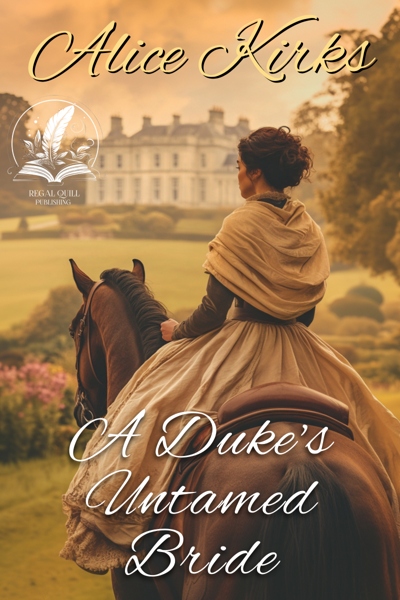
Anne Chamberlain drew the brush along Selene’s flank with vigorous, practiced circles, her wrist loose, her grip firm.
The mare shifted her weight, a massive ripple of muscle beneath a fiery chestnut coat, and blew softly through her nostrils. The scent of the stable—sweet hay, oiled leather, and the warm, earthy musk of horseflesh—was the only perfume Anne had ever truly cared for.
“There you are, girl,” Anne said, her voice low and even, a soothing vibration that seemed to settle the animal’s flighty spirit. “You earned your oats today. That hedge was higher than I thought, but you took it like you had wings.” She paid special attention to the base of Selene’s mane at her withers, and smiled as her mare sighed and leaned into the attention.
Selene flicked an ear back toward her. The mare’s dark eye watched her mistress with a keen, intelligent gaze. Anne leaned closer, resting her cheek briefly against the warm curve of the mare’s shoulder. She could feel the steady thrum of Selene’s heart. It was a simple, honest connection, devoid of the artifice that governed the rest of her world.
“You did not spook at the brook, and you did not throw me when the hounds cut across us. I call that a triumph,” Anne whispered.
“Anne.”
The scandalized voice was sharp, a jagged stone thrown into a still pond. Anne did not look up. She smoothed her palm along Selene’s neck instead, satisfied that the slight dampness of sweat was no longer clinging to the hide.
“If you are here to tell me I have ruined my garments, Aunt, you may find me indisposed. I am very busy congratulating my faithful, intelligent horse, and she does not care for the tone of a disappointed matron.” Anne broke a carrot and fed a piece to Selene with each compliment, letting the crunching punctuate her words.
Aunt Catherine’s sigh carried across the stable, thin and sharp as a pin. “I would not need to worry over you if you would simply behave in a manner that allowed you to be found in respectable rooms. I have been searching the house for nearly an hour, only to find you hidden in the dirt.”
Anne straightened at last, the wooden back of the brush clicking against the grooming box. She turned, one eyebrow lifting slightly as she surveyed her aunt. Catherine Chamberlain stood just inside the doorway. Her fashionable morning gown of pale lavender silk looked utterly ridiculous against the backdrop of straw, dust, and manure. The older woman held a lace handkerchief firmly to her nose, her eyes darting around warily as if the dirt itself were plotting against her.
Aunt Catherine’s gaze fixed with unmistakable horror on Anne’s lower half. “You are wearing trousers.”
Anne glanced down at herself as if noticing the garment for the first time. The buff-colored buckskins were snug—dangerously so—molding to the curve of her thighs and the strength of her calves. They were a man’s garment, stolen from her brother’s wardrobe years ago and tailored in secret.
They allowed her to straddle a horse. Anne liked to feel the power of the animal beneath her, and to move with a freedom that no riding skirt could ever afford. The side saddle was far too restrictive.
“I am,” Anne said simply.
“Like a man,” Catherine hissed, stepping further into the dim light of the stable, her eyes darting around to see if any of the staff were eavesdropping.
“Like an equestrian,” Anne corrected. She felt the familiar spark of rebellion heating her blood. “A side-saddle is a decorative cage, Aunt. I have no desire to be a decoration.”
“Anne, please.” Catherine’s voice dropped to a frantic whisper. “The impropriety…if anyone were to see you, the scandal would be irrecoverable. You are a lady of birth.”
Anne straightened and folded her arms across her chest. The motion drew the fabric of her white linen shirt tight across her shoulders, and she ignored a soft, disapproving hiss from Catherine. A loose strand of dark hair had worked its way free of her simple bun, sticking to the damp skin of her neck. She pushed it back with a rough, impatient gesture.
“Selene does not care. The grooms do not care. I care that I can mount without assistance and ride without tearing silk. Who remains to be offended? The mice in the rafters?”
The nearest groom, a young man named Jacob who had straw in his hair and a permanent smudge of dirt on his cheek, abruptly found the far wall fascinating. He began polishing a bridle with a fervor that suggested his life depended on the shine of the buckles.
Aunt Catherine lowered her voice further, her face pale. “The ton cares. Word travels, Anne. It travels on the wind. The villagers talk, the neighbors whisper, and eventually, the talk reaches London.”
Anne tilted her head, a slow, predatory smile touching her lips. “Then the ton should stop peering into my stables. Or perhaps they should find a hobby more productive than monitoring the bifurcated garments of a spinster. Is London truly so boring that there is nothing to gossip over other than my wardrobe? Have I made the front page of your social papers?” Anne swooned dramatically. “Oh, it is all I ever dreamed, the ton remarking upon my every move, tell me, Aunt, are the trousers scandalous because they look uncouthly fetching on me?”
She stepped past her aunt, her boots clicking firmly on the stone floor. She reached for a damp cloth, wiping the dust and horsehair from her hands. The friction of the rough fabric against her skin felt grounding.
“You did not come all this way to scold me about clothing, Aunt. You never do. You loathe the smell of the stables too much to visit simply for a lecture on fashion. What is it?”
Aunt Catherine followed Anne deeper into the stable, her skirts gathered carefully in one hand to avoid the floor, while the other hand still desperately clutched a handkerchief to her nose. Anne could smell the perfume upon it from steps away, thicker and more cloying than the scents of clean leather and fresh straw.
“I came because I was told you had been riding since dawn and had not yet changed. It is nearly noon, Anne. The day is half gone.”
Anne smiled faintly, the expression not reaching her eyes. “An excellent reason not to change. If the day is half gone, I have only a few hours of freedom left before the sun sets.” Conversing with her aunt did nothing to slow Anne down as she sailed through the midday routine of tidying up, Catherine shadowing behind her, more flighty than any of the horses ever were.
“And because,” Catherine continued, her voice trembling slightly, “people are beginning to talk about more than just your clothes. They talk about your independence. They talk about how you run this estate as if you haven’t a man in the world to guide you.”
Anne stopped at the next stall, picking up the gelding’s hoof to check his frog for stones after his time in the pasture. She worked with practiced efficiency, her fingers nimble and strong. “London people always talk, Aunt. It saves them from the exhausting labor of thinking.”
“Anne!”
Anne set the hoof down with a heavy thud and turned. Her expression sharpened, the icy look that so many in the ton found off-putting. It wasn’t coldness; it was the look of a woman who had seen the ledger books and knew exactly how much the grain cost, and what weather and footing were best avoided for turnout.
“Say it plainly, Aunt Catherine. We are alone, save for the horses, and they are excellent keepers of secrets.” Anne ignored Jacob, who was still furiously scrubbing the same spot of the gleaming bridle he’d hung on the far wall, clearly unwilling to pass the bickering women to return it to the tack room.
Aunt Catherine hesitated, her lip trembling. She lifted her chin, trying to regain some semblance of matriarchal authority. “If you ever hope to make a respectable match, you must stop this. No man wants a wife who behaves as if she has no need of him. A husband requires a woman who is soft, who is yielding. You are…you are like an oak tree. Sturdy, yes, but impossible to bend. You will uproot yourself fighting the wind.”
Anne laughed. It was a short, unamused sound that echoed off the timber beams. “Then I shall save some poor man a lifetime of disappointment. I have no desire to be bent, Aunt. Nor do I have any desire to be a wife. Marriage is a contract in which a woman signs away her authority, her property, and her very identity, and is told she has gained ‘protection’ in the exchange. I already protect myself. I manage the accounts, I oversee the harvest, and I train my own horses and hounds. What could a husband possibly offer me that I do not already possess?”
Catherine gestured helplessly, her lace-trimmed sleeves fluttering. “You are six and twenty! The bloom is off the rose, Anne. Soon, you will not even have the choice.”
“I am six and twenty,” Anne agreed, her voice ringing with hard-won pride. “And I am still in full possession of my name, my estate, and my senses. I call that a victory, not a tragedy.”
“The world is not kind to women alone. When your brother marries, when I am gone…what then?”
Anne’s gaze flicked briefly to the stable doors, where the afternoon light slanted across the packed earth in golden bars. “I am not alone.”
She turned toward the back of the stable and called out, “Jacob, has Honor been off on his near fore? He felt a bit heavy on the descent from the ridge when I hacked him this morning.”
Jacob stepped forward at once, his cap pulled low but his expression respectful. He didn’t look at her as a “lady” to be coddled; he looked at her as the person who paid his wages and knew the difference between a stone bruise and a strain.
“No, Miss Anne. He came in clean as a whistle. I reckon he was just tired. That ridge is a long pull in this heat.”
“Good,” Anne said, nodding. “Reduce his feed tonight. He worked hard, but I don’t want him getting spirited if he’s resting tomorrow. And make sure the mash is warm.”
“Yes, miss. Right away.”
Catherine watched the exchange with a mixture of pride and profound distress. “The stable hands listen to you as if you were a man. It is…unnatural.”
Anne shrugged, a languid motion of her shoulders that felt entirely natural to her. “They listen because I know what I am saying. Knowledge is not a gendered trait, Aunt, though the House of Lords and your omniscient ton might disagree.”
She strode toward the door, her long legs eating up the distance. Ajax and Hector, her two massive hounds—a mix of deerhound and something altogether more rugged—had been lying in patient, shaggy heaps just outside the threshold. The moment her shadow crossed the line, they surged to their feet, their tails whipping the air.
“There you are,” Anne said, bending down to scratch Ajax behind the ears. The dog leaned his heavy head against her thigh, his wiry coat rough under her fingers. “I thought you had abandoned me for the kitchen scraps.”
The hounds thrummed with excitement, leaning into her hands. They were large enough to be intimidating to a stranger, but with Anne, they were shadows, gamboling around and over each other like otters.
Catherine followed her out into the sun, her breath coming in short, panicked gasps as she tried to keep up with Anne’s confident stride. “Anne, slow down! My heart cannot take this pace.” The perfumed handkerchief waved like a flag of surrender.
Anne lengthened her stride instead, crossing the yard toward the manicured gardens. The contrast between the wildness of the stables and the order of the rosebushes was striking. “If you have more to say, Aunt, you must keep pace. I have work to do in the study.”
“You cannot go into the house dressed like that,” Catherine pleaded, her face flushing a deep pink. “The servants…the neighbors…”
“I can,” Anne replied without looking back. “I have done so before, and the house has not yet collapsed into the cellar.”
Catherine caught up at the edge of the gravel path, her hand darting out to grab Anne’s sleeve. “Your brother is inside.”
Anne stopped dead. The hounds sensed the change in her energy and sat instantly, their gazes fixed on the house.
Catherine took advantage of the pause, smoothing her skirts and trying to catch her breath. “Thomas arrived this morning. He did not send word…He simply appeared. He is in the drawing room, and he asked for you the moment he stepped off the carriage.”
Anne’s lips curved into a slow, mischievous smile. The friction between her and her brother was a long-standing tradition—a battle of wills between the man who lived in the city and the woman who ruled the country. “Did he indeed? My dear brother, the harbinger of London gossip. I wonder if he shall order a sketch of me in my trousers to grace the ton’s social papers for tomorrow’s edition.”
“He wishes to see you immediately. He looked…troubled, Anne. More than usual.”
Anne considered this, one hand resting on Ajax’s broad head. She could feel the dog’s comforting warmth through her trousers. “That is unfortunate. I had planned to avoid him until supper. I find Thomas is much easier to digest when accompanied by a glass of sherry and a roast.”
“This is serious, Anne. He did not come to discuss the weather or the price of wool.”
Anne turned her head slowly, her dark eyes searching her aunt’s face. “Is it?”
Catherine nodded solemnly. “Very. He has been pacing the rug since he arrived. He refused even a biscuit.”
Anne’s eyes brightened with a sudden, wicked light. The prospect of a confrontation—especially one where she held the visual advantage of being unladylike—was too tempting to resist. “Then I absolutely must not change. I cannot allow him to languish while I drape myself in fine silks.”
She resumed walking, her pace even faster than before.
“Anne!” Catherine cried, hurrying after her. “You will mortify him! He is your brother, and he has a position to maintain!”
Anne glanced over her shoulder, her grin sharp and dangerous. “That is entirely the point, Aunt. If Thomas wants my attention, he must take me as I am: dirt, hounds, trousers, and all.”
She burst confidently through the garden doors, the hounds trotting at her heels. The drawing room smelled of lemon oil, beeswax, and the faint, acrid scent of coal smoke from the small fire burning in the grate. It was a room designed for tea and polite conversation, all spindly legs and floral brocade.
Thomas Chamberlain, the Marquess of Heronswood, stood near the window, his hands clasped tightly behind his back, shoulders visibly tense even from across the room. He was dressed smartly. The latest whim of London’s fashion had him in a perfectly tailored frock coat of charcoal wool, his cravat tied in a knot so precise it looked like a work of architecture. He turned as the doors swung open.
He froze, even his chest stilling as his breath stopped coming. His gaze traveled from Anne’s windswept hair, down her sweat-stained linen shirt, to the buckskins that left nothing to the imagination regarding her legs, and finally to the two muddy hounds currently sniffing his expensive boots.
“I see you are as ladylike as ever,” he said, his voice a dry rasp.
Anne didn’t wait for an invitation. She dropped into a velvet-backed chair, crossing her ankles and stretching her legs out in a way that was profoundly masculine. “And I see you have not lost the ability to state the obvious, Thomas. To what do I owe this unannounced occasion? Have you run out of things to do in London, or did the fog finally become too thick to breathe?”
Thomas winced, his jaw tightening. He looked at the hounds, then back at his sister. “Must you always greet me as if we are adversaries in a duel? I am your brother, not a debt collector.” He winced at his own words.
Anne leaned back, studying the lines of tension around his eyes. Thomas was practical, yes, but he was also transparent to those who knew him. “You only visit when something is wrong, or when you want something. Since you haven’t mentioned the horses, I assume it’s the latter. Now speak. You’re getting mud on your boots just standing in my presence.”
Thomas paced once, the heels of his boots clicking on the hardwood border of the rug. He stopped and looked at her, his expression uncharacteristically grave. “There is a matter that requires your cooperation. A matter of some urgency.”
Anne raised an eyebrow. “Cooperation? That sounds ominous. Did you lose a bet? Or has Aunt Catherine finally convinced you to sell the north pasture?”
“It is important,” he said, ignoring her jab and speaking with a careful, measured cadence, “that the family presents a united front. Our reputation is…delicate.”
Anne’s smile faded. She felt a cold prickle of apprehension in her chest. “To whom must we present this front? And why now?”
He hesitated, his gaze drifting to the window.
Anne leaned forward, her hands gripping the arms of the chair. “Thomas. Look at me. You didn’t ride all this way just to talk about ‘fronts.’ What has happened?”
He met her gaze at last, and for the first time, Anne saw a flicker of genuine fear in his eyes. “An important visitor will call upon us. Not here, but in London. At the townhouse. In two days’ time.”
Her eyes narrowed. “Why? We haven’t been to London for the Season in years. And who is this visitor that requires me to leave my stables?”
“It is not my place to say,” he deflected, his voice tight. “Not yet.”
Anne stood up abruptly, her hounds rising with her like twin sentinels. “Then it is not my place to cooperate. If you cannot be honest with me in our own home, Thomas, then I see no reason to play the part of the dutiful sister in yours.”
Thomas’s jaw tightened until a muscle jumped in his cheek. “Anne, don’t be difficult. Not this time.”
She moved closer, stopping an arm’s length away. She was shorter than him, but in her trousers and boots, she felt like the one with the higher ground. “You are hiding something. I can see it in the way you will not meet my eyes. Is it the estate? Have you trouble in the city?”
“I am protecting you,” he snapped, his composure finally breaking.
“From what? I don’t need protection from the truth, Thomas! I need the truth so I can deal with it!”
He looked away, his shoulders sagging slightly under the weight of his fine coat. The silence in the room grew heavy, thick with the unsaid things that had been rotting between them since their father’s death a year earlier. He’d lost control of his phaeton one evening while coming back from his club after losing a vast sum.
Their mother, Arabella, had died of a fever when Anne was a baby, and their father had struggled with the responsibilities of caring for his children on his own. James Chamberlain had been a foolish man who had depleted the family’s coffers with drink and gambling. Thomas had soon been sent off to school, while Anne was tended to by a series of nannies and governesses. They were never close while growing up, and Anne preferred to spend her time with the horses, rather than with her meddling brother.
Anne folded her arms, her heart hammering against her ribs. “If I say no? If I stay here and continue my life as I have planned it?”
Thomas closed his eyes briefly. When he opened them, the frustration was gone, replaced by a quiet, desperate sincerity. “Even you, Anne…even you are not so cruelly independent as to leave the family in trouble. If you do not come, if you do not play your part…we will lose everything. Chamberlain Park. The horses. All of it.”
Anne studied him in silence, the air suddenly feeling as thin as it did in the London ballrooms she loathed. Ajax pressed his heavy head against her leg, sensing her distress. Hector watched Thomas intently, a low whine vibrating in his throat.
The autonomy she craved, the independence she had fought so hard to build, all suddenly felt like sand slipping through her fingers.
At last, she spoke, her voice like flint. “You should have led with that, Thomas. When do we leave?”
Chapter Two
Alistair Edwards, the Duke of Calderwick, stood at the gate of the lower paddock with his leather-bound notebook braced against his broad palm. His pencil moved in neat, decisive strokes, the graphite scratching a rhythmic accompaniment to the morning’s quiet. Before him, Vaughn, a stallion of immense power with a gleaming bay coat, pranced along the fence line.
The horse moved with a measured, high-stepping grace that Alistair found deeply satisfying. Each time the beast passed, Alistair’s dark gaze followed the play of muscle beneath the hide, assessing the animal’s gait with the same cold precision he applied to his accounts.
“Lengthened stride today,” Alistair murmured, his voice a low baritone that barely carried over the wind. “Though he is still favoring the right foreleg ever so slightly on the turn.”
The head groom, standing a respectful three paces back, nodded quickly. “Only when he turns sharp and above a trot, Your Grace. He’s a bit eager this morning. Happy to be feeling improved, methinks.”
Alistair made a sharp mark on the page. “Reduce his oats by a quarter for the evening. Walk him for thirty minutes after his grooming. No galloping until the heat of the day has passed.”
“Yes, Your Grace. At once.”
“You know,” a new voice drifted from the left, dripping with an easy, unearned indolence, “most men come out to their paddocks to admire the beauty of God’s creatures. You, Alistair, appear to be performing an autopsy on a living animal.”
Benedict Hawthorne leaned against the fence rail, his arms folded across a waistcoat of remarkably garish canary yellow. He was the second son of an earl and possessed all the charm that Alistair had spent his life trading for responsibility. Benedict’s boot was crossed casually over the other, his hat tilted at a daring angle that would have made a dancing master weep.
Alistair did not look up from his notes. “Beauty without discipline is merely a wasteful distraction. A horse of this caliber is a tool of the estate, Benedict. It must be maintained.”
Benedict snorted, pushing off the fence to stand closer. “You say that as if it applies only to horses. I suspect you view your own morning shave with the same grim sense of maritime law.”
Alistair finally turned a page, his movements stiff and controlled. “If you have come all this way to distract the staff from their duties, you may leave through the south gate. The walk will do your constitution good.”
“I have come,” Benedict replied, flashing a grin that had excused a thousand sins since their days at Eton, “because you summoned me to discuss the grain prices, and because I enjoy watching you pretend that you are not immensely pleased by my company.”
Alistair’s mouth twitched, a minuscule movement that was the nearest he ever came to a smile in public. “You are twenty minutes late. The grain merchant has already been and gone.”
“I was detained,” Benedict said, his expression becoming mock-solemn. “By a rather charming widow in the village who wished to know whether I preferred my tea strong or scandalous. I found it impossible to be rude to a lady in distress.”
“And?” Alistair asked, finally closing the notebook with a soft, authoritative snap.
“I took both,” Benedict said with a wink. “The tea was excellent. The scandal remains to be seen. I do hope they use a more flattering sketch of my profile for the papers this time. The last one had the nose all wrong.”
Alistair slipped the notebook into the breast pocket of his impeccably tailored coat. The wool was fine, hugging his broad shoulders in a way that spoke of both wealth and a man who did not care for the fripperies of fashion. “You will regret the indulgence by the afternoon. Indiscretion is a debt that always collects interest.”
“Possibly,” Benedict said, falling into step as they began walking the perimeter of the fence. “But I shall regret it with far more enthusiasm than you will ever spend on balancing your books and accounts.”
They walked in silence for a moment, the sound of their boots crunching on the damp gravel. The morning air was thick with the scent of wet grass and the sharp, clean aroma of the stables. Vaughn slowed as they passed, his ears flicking toward Alistair. The duke stopped, resting a large, gloved hand on the top rail.
“Good,” Alistair murmured, watching the horse. “He listens.”
“He fears you,” Benedict corrected exaggeratedly, watching the way Alistair’s presence seemed to command the very air around him. “As all sensible creatures do when faced with such an unyielding wall of ducal propriety.”
Alistair’s jaw tightened, the line of his throat showing above his cravat. “He respects consistency. He knows exactly what I expect of him, and he knows that I will not fail to provide what he requires. It is a fair exchange.”
Benedict studied his friend’s profile—the straight, aristocratic nose and the jawline that looked as though it had been carved from granite. “You truly believe that respect and fear are the same thing.”
“They are,” Alistair replied, his voice devoid of emotion. “In any practical application of authority or exchange.”
They moved on, passing the gate to the upper paddocks where the newer stock was kept. Benedict gestured toward a sorrel mare that was pacing nervously near the far hedge. “Is that the one you bought at the Tattersalls’ auction? She’s a bit skittish, isn’t she?”
“She was mishandled by her previous owner,” Alistair said, his eyes darkening. “He lacked the patience to understand her rhythm. Now, she views every approach as a threat.”
Benedict grimaced. “Aren’t we all a bit like that after a few Seasons in London? Mishandled and wary of the bit.”
Alistair shot him a look of profound boredom. “Speak plainly or not at all, Benedict. I have a meeting with the bailiff at one.”
Benedict sighed, his playful demeanor slipping just enough to reveal the concern beneath. “Very well. When do you intend to stop avoiding the capital? You have been buried here at Calderwick for three weeks, and the invitations are beginning to pile up like snowdrifts against your front door.”
“I am not avoiding London,” Alistair said, though the lie felt heavy in his mouth. “The estate requires my presence. The breeding program is at a critical juncture. I am integrating bloodstock tracing back to the Byerly Turk.”
“You always have work,” Benedict challenged. “Yet somehow, last year, you managed to attend three state dinners and one exceedingly dull musicale without the world ending. Why the sudden retreat?”
“Duty,” Alistair said, the word a shield he had used since he was ten years old.
“Ah,” Benedict replied, his tone sharpening. “That noble, tireless beast. Does duty also explain why you have not answered a single inquiry from the Clements family regarding your…intentions?”
Alistair’s stride did not falter, but his hand clenched briefly at his side. “Those inquiries do not require an answer. The matter was settled when Eliza chose to spend the better part of the spring dancing with a viscount’s heir in Brighton.”
“She made a mistake, Alistair. Everyone knows she was young and foolish, and her parents are desperate to repair the bridge.” Benedict stepped in front of him, forcing Alistair to halt. “People enjoy arranging your life for you because you are a duke, and a duke without a duchess is a vacuum that nature—and society—abhors.”
“Then society will have to learn to live with the void,” Alistair said. “I have no interest in being a prize for the Clements’ mantelpiece.”
“And yet,” Benedict said, leaning back against a gatepost, “one cannot help but wonder if you ever intend to marry at all. Or do you plan to leave the dukedom to that cousin of yours who spends all his time in the opium dens of Paris?”
Alistair exhaled slowly, a cloud of white mist in the chilly air. He looked past Benedict toward the horizon, where the gray stone of the manor house loomed over the trees. “The matter of my marriage is already sorted.”
Benedict blinked, his mouth falling open in genuine shock. “It is? To whom? When did this happen? I haven’t seen a single announcement in the Gazette. You’ve not mentioned courting anyone.”
“There will be no announcement until the contracts are finalized,” Alistair said, attempting to move past his friend.
“You cannot simply say something like that and continue walking as if you’ve just commented on the weather!” Benedict scrambled to catch up.
“I can,” Alistair said. “And I am.”
“Alistair, stop.” Benedict grabbed his arm. It was a bold move; few people touched the Duke of Calderwick without an invitation.
Alistair stopped and faced him fully, his height making the younger man look small. “What do you want, Benedict?”
“The truth,” Benedict said, his eyes searching Alistair’s face. “Or at least a version of it that does not sound like you are reciting an inventory of grain. Who is she?”
Alistair regarded him for a long, silent moment. He felt the familiar weight of his upbringing—the lessons that taught him that emotion was a vulnerability to be mastered, not shared. “There is nothing romantic about this, Benedict. It is a transaction that was set in motion long ago to settle a debt.”
“Of course it is,” Benedict said, his voice dripping with sarcasm. “Heaven forbid you should feel a spark of warmth for the woman you intend to spend forty years with. You once intended to marry Eliza because you thought it was ‘practical.’”
“It was,” Alistair said, his jaw tightening. “We were of compatible rank. Our estates shared a border. It made perfect sense.”
“And it was painful when she left,” Benedict added gently. “Admit it, Alistair. You were hurt.”
“I was inconvenienced,” Alistair corrected, his voice dropping an octave. “I had spent three years preparing for that alliance. When she turned her eye elsewhere, it was a failure to account for human nature in my planning. Nothing more.”
Benedict raised an eyebrow, his expression skeptical. “If you say so. But if Eliza is back in London—and she is, I saw her carriage on Monday—why are you suddenly betrothed to someone else?”
Alistair looked away toward the horses. The mention of Eliza did not stir the old flame, but it did stir the old resentment. He hated the fickleness of it all. “The chapter is closed. I do not care where she spends her time or with whom she dances. I do not indulge in sentiment, Benedict. It is a messy, unreliable emotion.”
“That must make life dreadfully efficient,” Benedict said, shaking his head.
“It does,” Alistair replied.
Vaughn approached the fence again, lowering his massive head. Alistair extended his hand, palm flat. He allowed the stallion to sniff his fingers, the hot breath of the animal warming his skin through the leather of his glove. He stroked the horse’s neck once, a rare gesture of affection that he would never have shown to a human.
“You see,” Benedict said quietly, “you are not immune to affection. You just prefer it from creatures that can’t talk back.”
Alistair withdrew his hand and straightened his coat. “You wished to know about my upcoming marriage. It is an obligation. An old one, inherited from my father.”
Benedict’s expression shifted from amusement to genuine intrigue. “How old?”
“Older than either of us,” Alistair said. “My father and the late Mr. Chamberlain entered into a private agreement many years ago. It was a matter of a significant debt…One that could not be paid in coin without ruining the Chamberlain name.”
Benedict frowned, his brow furrowing as he sifted through his mental library of scandals. “Chamberlain…of Chamberlain Park? The family with the famous stables in the North?”
“The same,” Alistair said. “I did not know of it until my father was on his deathbed. They had been friends at school, and James Chamberlain lost quite a bit at the gambling tables after his wife died. My father came up with the idea to unite the families through marriage. He’d cover James’ debts, and we would combine our horse breeding programs. James was a fine horse breeder, and there are horses descended from the Byerly Turk in his stables. His daughter is quite the horse enthusiast, too.”
“Wait,” Benedict said, his eyes widening. “The daughter? I have heard of her. Anne Chamberlain. They say she manages the entire estate herself. Rumor has it she rides astride like a man and refuses to wear a corset if she can help it.”
Alistair’s expression remained neutral. “So I have heard.”
Benedict stared at him, a low whistle escaping his lips. “You are not serious. You mean to tell me that the Duke of Calderwick—the most traditional, buttoned-up, rule-abiding, no-nonsense, boring man in the peerage…is bound to marry a woman who behaves like a wild stable boy?”
“The contract is binding,” Alistair said, though a small, sharp prick of apprehension pricked at his mind. “It was signed and witnessed. Mr. Chamberlain’s debt was forgiven in exchange for the union of our houses. My father gave his word, and I will not see the Calderwick name associated with a broken promise.”
“And she knows this?” Benedict asked.
“I find that doubtful,” Alistair said. “Her brother, Thomas, is the only one who has been privy to the correspondence. He is…concerned about her reaction.”
“I imagine he is!” Benedict laughed, a bright, genuine sound. “That is rather monstrous, Alistair. You’re essentially buying a wife to settle a dead man’s gambling debts.”
“It is honorable,” Alistair countered, his voice rising in volume. “I am saving her family from bankruptcy and her brother from debtors’ prison. In exchange, I fulfill my duty to provide an heir and maintain the stability of my house.”
“It is archaic,” Benedict muttered.
“It is my life,” Alistair said.
Benedict paced a short circle on the gravel, his yellow waistcoat flapping. “And you feel nothing about this? No curiosity? No fear that you’re inviting a whirlwind into your library?”
“I feel responsibility,” Alistair said. “I have researched the lady’s reputation. She is independent, yes. She is unconventional. But those are mere personality traits. They are irrelevant to the legal and social obligations of the marriage.”
Benedict stopped in front of him, his eyes sparkling with a dangerous mischief. “You are lying to yourself. You’re terrified.”
Alistair stiffened, his shoulders squaring as if he were facing a challenger. “Mind yourself, Hawthorne.”
Benedict smiled faintly. “You are concerned that you cannot control her with a notebook and a set of rules. You’re prepared for a battle, aren’t you?”
“I am prepared to treat her fairly,” Alistair said. “She will have her own rooms, a generous allowance, and the freedom to pursue her interests, provided she does not bring scandal upon the name. I do not expect us to spend much time together after the wedding.”
“And love?” Benedict asked softly. “Do you not think she might want more than a ‘generous allowance’?”
“There is no such thing as love,” Alistair replied, his voice flat. “Not as you dream it, not as the poets write it. There is compatibility, mutual respect, and there is duty. Anything else is a fever of the blood that passes with the first frost.”
Benedict tilted his head, his gaze softening. “You once imagined it. With Eliza.”
Alistair said nothing, but the muscles in his jaw worked rhythmically.
Benedict’s smile returned, gentler now. “You may find, Alistair, that Miss Anne Chamberlain does not conform to your careful notes and rigid routine. In fact, I suspect she might be the first person in a lifetime to tell you to go to the devil.”
“That remains to be seen,” Alistair said, though the thought of a woman defying him sent a strange, unfamiliar jolt through his chest, not unlike the way he felt when he noticed that sorrel mare at auction, seeing her for the diamond in the rough that she was.
“And you may even like her,” Benedict teased. “I’ve heard she’s quite handsome in a sturdy, country sort of way. Perhaps her wild ways will get you to loosen that cravat and actually enjoy a meal without checking your watch.”
Alistair scoffed, turning back toward the house. “Unlikely. I value order. She represents chaos.”
“Chaos is just order that hasn’t been invited to tea yet,” Benedict said, falling back into step. “I rather hope she gives you hell. Imagine, a fellow horse breeder to argue with, one who understands what you mean when you try to convince me that all horses have pet frogs.”
“Again, the frog is a delicate structure on the sole of the hoof.” Alistair sniffed.
“Imagine never having to explain that again.”
Alistair didn’t respond, but he felt the weight of the notebook in his pocket. He had a plan. He always had a plan. But for the first time in his life, he felt as though he were walking toward a hedge that was just a bit too high to jump.
“When do you meet her?” Benedict asked.
“Soon,” Alistair said. “Thomas is bringing her to London this week. I shall call upon them in two days.”
“And you feel nothing?”
Alistair paused, his pencil tapping once, twice against the cover of his notebook. He thought of the rumors of the girl who rode like a man and managed an estate alone. He thought of the friction that was surely coming.
“I feel prepared,” he said.
Benedict laughed quietly, the sound echoing in the crisp morning air. “The most dangerous state of all, Alistair. The most dangerous state of all.”
OFFER: A BRAND NEW SERIES AND 2 FREEBIES FOR YOU!
Grab my new series, "Delightful Dukes and Damsels", and get 2 FREE novels as a gift! Have a look here!
Hello, my dears! I hope you all enjoyed my little surprise, and I look forward to reading your comments here. Thank you so much! 🥰